
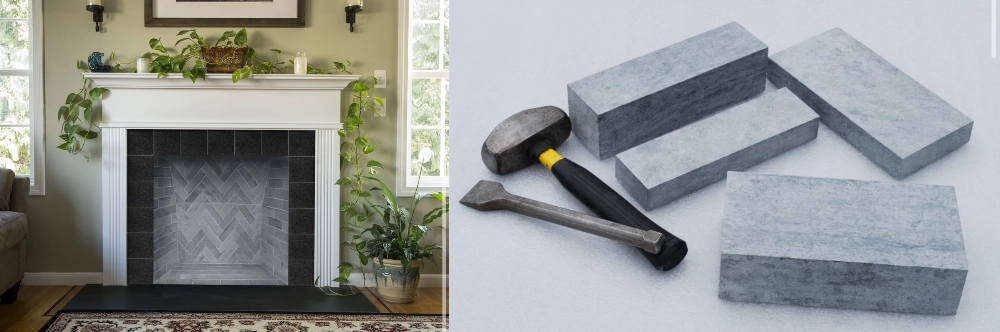
Soapstone vs. Traditional Firebrick: Which Material Is Right for Your Project?
When building or restoring a fireplace, masonry heater, wood stove, or pizza oven, selecting the right firebrick is one of the most important decisions you’ll make. While traditional refractory firebrick has been the industry standard for decades, soapstone firebrick has become increasingly popular among homeowners, builders, and masonry professionals looking for superior heat retention and long-term performance.
Understanding the strengths of each material will help you choose the best option for your specific application.
What Is Traditional Firebrick?
Traditional firebrick is a refractory ceramic material manufactured to withstand extremely high temperatures. It has long been used to line fireplaces, wood stoves, kilns, furnaces, and industrial heating equipment because it is durable, readily available, and capable of handling repeated heating and cooling cycles.
Firebrick performs exceptionally well in environments where direct flame resistance is the primary requirement.
What Is Soapstone Firebrick?
Soapstone firebrick is cut from natural soapstone, a dense metamorphic rock that has been valued for centuries for its exceptional ability to absorb, store, and gradually release heat.
Unlike manufactured firebrick, soapstone is a natural material with a distinctive appearance and unique thermal properties. Its combination of density and heat storage makes it an outstanding choice for applications where long-lasting radiant warmth is desired.
Heat Retention
One of the biggest differences between the two materials is how they manage heat.
Traditional firebrick heats relatively quickly and performs well while the fire is actively burning. Once the fire begins to die down, however, it generally releases its stored heat more quickly.
Soapstone absorbs heat more gradually, storing a significant amount of thermal energy throughout the burn. After the fire has gone out, that stored energy is released slowly over many hours, providing comfortable, even radiant heat long after the flames have disappeared.
For homeowners seeking longer-lasting warmth and improved efficiency, this characteristic is one of soapstone’s greatest advantages.
Thermal Mass Matters
Thermal mass refers to a material’s ability to absorb and store heat.
Soapstone’s higher density means more material—and therefore more stored energy—can fit into the same space. In many heating applications, this translates into greater heat storage compared to traditional firebrick of similar dimensions.
Instead of producing intense bursts of heat followed by rapid cooling, soapstone delivers a steadier, more consistent heating experience.
Durability
Both materials are designed for high-temperature environments and can provide many years of service when properly installed.
Traditional firebrick has an excellent reputation for withstanding direct flame and repeated firing cycles.
Soapstone is also highly durable while offering additional resistance to moisture absorption and excellent dimensional stability under normal heating conditions. Many installations remain in service for decades with minimal maintenance.
Appearance
Appearance is another area where the two materials differ considerably.
Traditional firebrick offers the familiar light-colored refractory look found in many fireplaces and stoves.
Soapstone provides a natural stone appearance with subtle variations in color and texture that create a more refined, custom-built look. Many homeowners appreciate that it blends equally well with rustic, traditional, and contemporary designs.
Common Applications
Traditional Firebrick is commonly used in:
- Fireplaces
- Wood stoves
- Furnaces
- Industrial kilns
- Commercial refractory installations
Soapstone Firebrick is an excellent choice for:
- Masonry heaters
- High-efficiency fireplaces
- Wood-burning stoves
- Pizza ovens
- Bake ovens
- Custom fireplace restorations
- Radiant heating projects
Which Material Is Best?
The answer depends on your priorities.
If your primary concern is a proven refractory material for standard high-temperature applications, traditional firebrick remains an excellent option.
If your goal is to maximize heat storage, enjoy longer-lasting radiant warmth, and create a premium natural stone installation, soapstone firebrick offers significant advantages that many homeowners and builders find worthwhile.
Frequently Asked Questions
Does soapstone withstand high temperatures?
- Yes. Soapstone has been used in high-temperature heating applications for generations and performs exceptionally well in fireplaces, masonry heaters, wood stoves, and pizza ovens when installed correctly.
Does soapstone store more heat than traditional firebrick?
- Because soapstone is denser and has excellent thermal mass, it can store more heat within the same volume and release that heat gradually over an extended period.
Is soapstone worth the investment?
- For projects where heat retention, efficiency, appearance, and long-term performance are important, many builders and homeowners consider soapstone to be a worthwhile investment.
Final Thoughts
Both traditional firebrick and soapstone firebrick have earned their place in high-temperature construction. Traditional firebrick remains a dependable refractory material, while soapstone offers the added benefits of exceptional heat storage, gentle radiant warmth, and timeless natural beauty.
Choosing the right material ultimately comes down to how you want your heating system to perform. If your goal is to enjoy warmth that continues long after the fire has burned down, soapstone firebrick provides a unique combination of thermal performance, durability, and aesthetics that few other materials can match.